Reviews

Must Read! Bold, insightful and eerily plausible
“A brilliant, entertaining and thought-provoking read that blends parenting with the unsettling possibilities of artificial intelligence. Engaging, clever and deeply resonant ...”
- Amazon Customer (verified)
AI Baby is a smart funny take on risks of AI
“A fabulous debut novel that manages to be both a love letter to Seattle and a cautionary tale about where artificial intelligence might take us — all while keeping you thoroughly entertained from first page to last.”
- jill allen (verified)
The newest must read book for summer!
“An entertaining page turner of a novel that intersects the age old story of parenting a teenager with the new and quickly evolving tech and AI landscape. …Celeste Garcia hits it out of the ballpark.”
- Customer (verified)
“The author’s wit and humor, combined with a compelling story that is very timely, makes for a book that was hard to put down.”
- Amazon Customer (verified)
Perfectly Timed Novel for Today — Couldn’t Put it Down!
“I’m a GenX Mom who just sent my one and only to college this year. To say how overwhelmed I am by AI and how it will affect my child from now to forever is an understatement. … Full of heart, humor — so clever and smart. A real page turner!!! … Watch out world, we have a vibrant new author and I hope there is more to come!!!”
- Stacy Jahn (verified)
“A fantastic fictional read. Witty and humorous yet at the same time eerily close to our potential non-fictional future reality. A story of love and friendship.”
- William M. Campbell, Jr. (verified)
Witty, relevant story that is hard to put down!
“An extremely entertaining and humorous portrayal of the crazy competitive college applications world, and the things a tiger mom will do to help her child be a success. …Love this book and hope to see it as a movie someday!!”
- Ring (verified)
“A page-turning thriller that keeps the tension high from start to finish. It is funny in unexpected moments, but I also found it deeply unsettling, creating a sharp contrast that makes the story even more gripping ...”
- gingergrace (verified)
“This novel is a funny and thoughtful look at competitive parenting taken to extremes with AI enhancement used to create a perfect child. The author’s voice is entertaining even as she explores some complex ideas about humanity and technology.”
- jill allen (verified)
“Super fun read. Fascinating and scary glimpse into the future of AI. A must-read!”
- Eva S. Wahl (verified)
Madison Park Times
Meet Your Neighbor: Celeste Garcia
By Jenny Martin
This is the latest feature in a new "Meet Your Neighbor" series designed to help you get to know your neighbors. Although Madison Park is a small community, it can sometimes feel large. To foster a stronger sense of community, this column will introduce you to your neighbors.
After reading each edition, you'll be able to put a name to a face and greet people like Celeste when you see her walking by. Celeste is a mom, a writer, and an advocate for the ethical use of AI. Her debut novel is called AI Baby.
What do you love about living here?
There's a spirit about Seattle. I think about its origins and the early pioneers and coming here and building something from nothing.
There's still sort of a rugged can-do aspect to the people who live here. My career was at Microsoft in marketing. And there was a can-do attitude, with people feeling like anything is really possible. I think people here are very smart, educated, and hardworking. are very smart, educated, and hardworking.
It's really unique for people who grow up here that they always know there's an option to attend a really great university in their own backyard. My son is going there now. And it's really been a big part of learning and curiosity and education that makes this a unique city.
What is the difference between how you prepared for university and how young people today prepare for admission?
When we were growing up, and I'm a Gen Xer, we were allowed to enjoy our childhood and be kids. It wasn't seen as a resume-building time, and childhood has become that. Raising my children, I tried not to overschedule them and over program them. My husband was really adamant that we always ate dinner together. And that made a huge difference.
Is there more pressure on kids today to succeed in school?
I feel bad for the new generations that there's just so much pressure. Any of the pressure that I had on me, I put upon myself. When we were growing up, I knew a lot of really gifted people who didn't care much about grades. They still ended up successful in adulthood, and we've defined success so much more narrowly now. I've struggled with this as a parent. And it's a big theme in my book—the pressure to succeed, along with how far children and parents might be willing to go for that competitive edge through the use of AI.
What inspired you to write your book, AI Baby?
I read an article in the newspaper about designer IVF and choosing the perfect sperm from an MIT professor, and then finding the perfect supermodel's eggs. And I thought, why don't they just create AI babies? And then the idea to write a novel about a reckoning for what it really means to be human, and how far a parent might go to enhance their child's ability to succeed in school.
You’ve written about ethics and AI; can you tell us more?
There are so many huge ethical questions about it. I touched on a lot of them in my novel, such as the bias in the training data. Then there's the egregious labor exploitation, and there are currently no real regulations. There have been some horrible examples of AI generative models steering people in unfortunate directions.
What could improve this situation?
What could be really effective is integrating AI ethics into the computer science curriculum, and it could cross many disciplines. If students were starting to think about it early on and thinking about the implications, that could make a huge difference in moving the needle forward. I would love to talk to anybody who has connections within UW about this possibility.
You've also written about the human factor in all of this...
We are living in a time when intelligence can increasingly be engineered. What we have left is human relations and love. And at the heart of my novel is a mother-daughter story.
©2026 Madison Park Times
The Microsoft Interview
Alumni Author Spotlight: Celeste Garcia
By Becky Monk
Before she was a novelist exploring the human consequences of artificial intelligence, Celeste Garcia was deep inside the systems that power it. In the late 1990s, during her time at Microsoft, she designed and delivered global training programs that helped bring complex enterprise technologies to life. It was work that demanded precision, scale, and the ability to navigate high-stakes environments.
That experience—operating at the intersection of technology, ambition, and pressure—left a lasting imprint. Today, as a Seattle-based writer, Celeste channels those insights into her storytelling, where questions of power, identity, and control take center stage. Her novel “AI BABY” begins with a seemingly familiar story of competition and achievement, but quickly unfolds into something far more unsettling: a search for truth inside the machinery of an AI-driven world.
At every stage of her journey, one instinct has remained constant: a refusal to simply accept the systems around her. Whether at Microsoft, as a parent, or now as an author, Celeste’s work is driven by a deep curiosity—and a willingness to ask what happens when the systems we build start to shape us in return.
Recently, we caught up with Celeste to talk about her novel… her broader body of work, and a consistent throughline: a willingness to question systems, challenge assumptions, and examine how the tools we build ultimately shape us.
Who should read “AI BABY?” “AI BABY” is for readers who enjoy smart, propulsive fiction. It’s for people drawn to stories where technology collides with family, ambition, ethics, and power. “Klara and the Sun” with a “Where Did You Go, Bernadette” swagger.
Your Substack “Getting Real About AI” and nonfiction collection “AI EVERYWHERE” dig into the realities of AI. What was it that inspired you to write fiction with AI at the center? I was reading an article in The Wall Street Journal about designer IVF. For the right price, couples could choose the “perfect” sperm — MIT professor, six feet tall — and pair it with a supermodel’s eggs. “Why don’t they make AI babies?” I said out loud at breakfast and declared it was my next book.
Fiction…provides a safe space to explore uncomfortable futures and ask, “What would I do?” It lets people feel the stakes in a way that might help them contemplate their future and how they fit with the current technological superstorm. In “AI BABY,” humor and narrative make complex ideas—like engineered intelligence, data manipulation, and algorithmic parenting—emotionally accessible and allow people to envision the future. For many readers, my novel is their first deep dive into AI in the ways that it will—and already is—permeating society. And even though it’s fictional characters and scenarios, the human struggles and technical aspects are real.
In literature, tension usually comes from human frailty or flawed institutions. In your work, does the danger typically come from technology itself or from the incentives, power structures, or belief systems surrounding it? And what made you want to explore this with “AI BABY?” Excellent question! In “AI BABY,” the danger doesn’t come from technology as an autonomous villain; it comes from the human frailty and institutional power structures that technology amplifies. Both my protagonist, Erica, and my antagonist, Lannie, are deeply flawed and ultimately seeking validation in ways that collide with one another. That creates the tension that propels the story.
AI doesn’t introduce new flaws, it seems to amplify what already exists and raises the stakes to a new level. What interested me as a writer was not so much what if technology goes wrong. I’m asking what happens when someone who lacks morals develops tools to serve their desires but are detrimental to humanity? Who will step up to stop them and is it even possible with such powerful technologies?
When writing fiction rooted in real innovation, are you trying to predict what will happen, prevent what might happen, expand the range of futures that leaders are willing to imagine, or just write an interesting tale? What’s the goal? I’m not trying to predict the future so much as expand the range of futures we’re willing to imagine—and emotionally engage with. I am not a futurist, and most of the futurists are getting it wrong. What I love about fiction is that it opens up possibilities and ultimately choice.
My overriding goal is to tell a compelling story that brings up big questions that will stick with the reader long after they finish the novel.
What technology do you use when you’re writing? LLMs are invaluable for my research. The convergence of AI with a vast number of disciplines, including bio- and gen-tech, CRISPR, material science, and nanotech are woven into my novel. I needed to build expertise but also articulate in a way that was accessible, so I didn’t lose a mostly non-tech audience. Even though it’s fiction, it was very important to me to have the technology be accurate for today and for futuristic elements to be believable.
Do you prefer to read a physical book or an eBook? I was a first-gen Kindle user. I read to fall asleep and also read when I wake up in the middle of the night.
Must have food or drink when writing? My college study food was Cool Ranch Doritos and Diet Coke. I’ve progressed to hummus, Mamnoon Muhammara, chocolate, and coffee—tons of coffee.
Did you like to read as a child? I was a voracious reader. My mother taught me to read when I was very young, so I don’t really remember not reading.
What was your favorite childhood book? That is a very big topic. My first favorite was “Go Dog. Go!” I went through the natural progression—“Charlotte’s Web,” Beverly Cleary, “Little House on the Prairie” and C.S. Lewis. I always loved the Greek myths.
Favorite literary hero or villain? Atticus Finch. No explanation required.
What’s the craziest and bravest thing you’ve ever done? I would say writing a novel. I’ve done plenty of things that required courage—anyone who worked at Microsoft has. I was eviscerated by a colleague during a presentation in front of hundreds of people, scrutinized in executive meetings, delivered bad news to hostile stakeholders, and lived constantly under the stress of impossible deadlines.
But writing is different. It’s a uniquely vulnerable act. You’re not defending an idea or strategy or performing when everyone is on your side—you’re broadcasting your inner thoughts to the world. You invite judgment not just of the work, but of your voice, your ability, your perspective.
What's next for you?I queued up a sequel at the end of “AI BABY.” I am also working on my chapter for the second installment of “AI EVERYWHERE.” I’m covering a subject I feel very passionate about, labor exploitation of “ghost workers.” There are hundreds of thousands of people across the globe working for pennies on the dollar to annotate and label the data that trains AI systems. I find it absolutely appalling.
Finally, a piece of advice for alumni aspiring to write and publish a book? Do the upfront work even though it’s annoying and feels like drudgery. This includes character arcs, plot points and detailed outlines. It pays off 10x in the writing process. Find a talented and very brutal editor. Know that a lot of your beloved prose will end up on the cutting room floor. One more thing, if you want to write a book, it is imperative that you start a Substack. It gets and keeps you writing, makes you relevant in your genre, and provides a community that is supportive. It also provides a built-in audience for marketing. Unlike social media, people on Substack have an attention span and are readers.
Excerpts from an interview published on June 3, 2026 for the Microsoft Alumni Network. ©2026 MS Alumni Network.
Book Launch Party
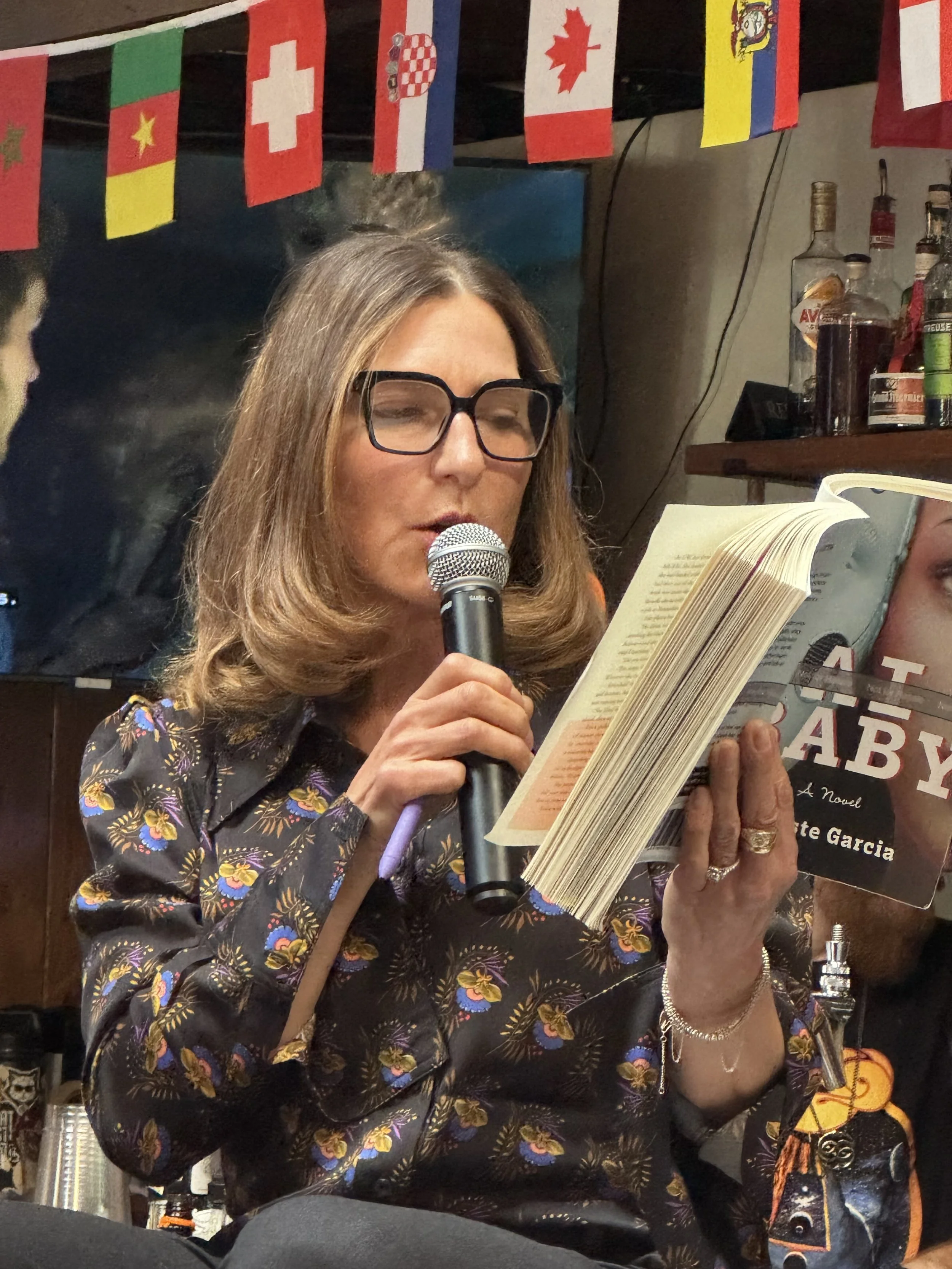
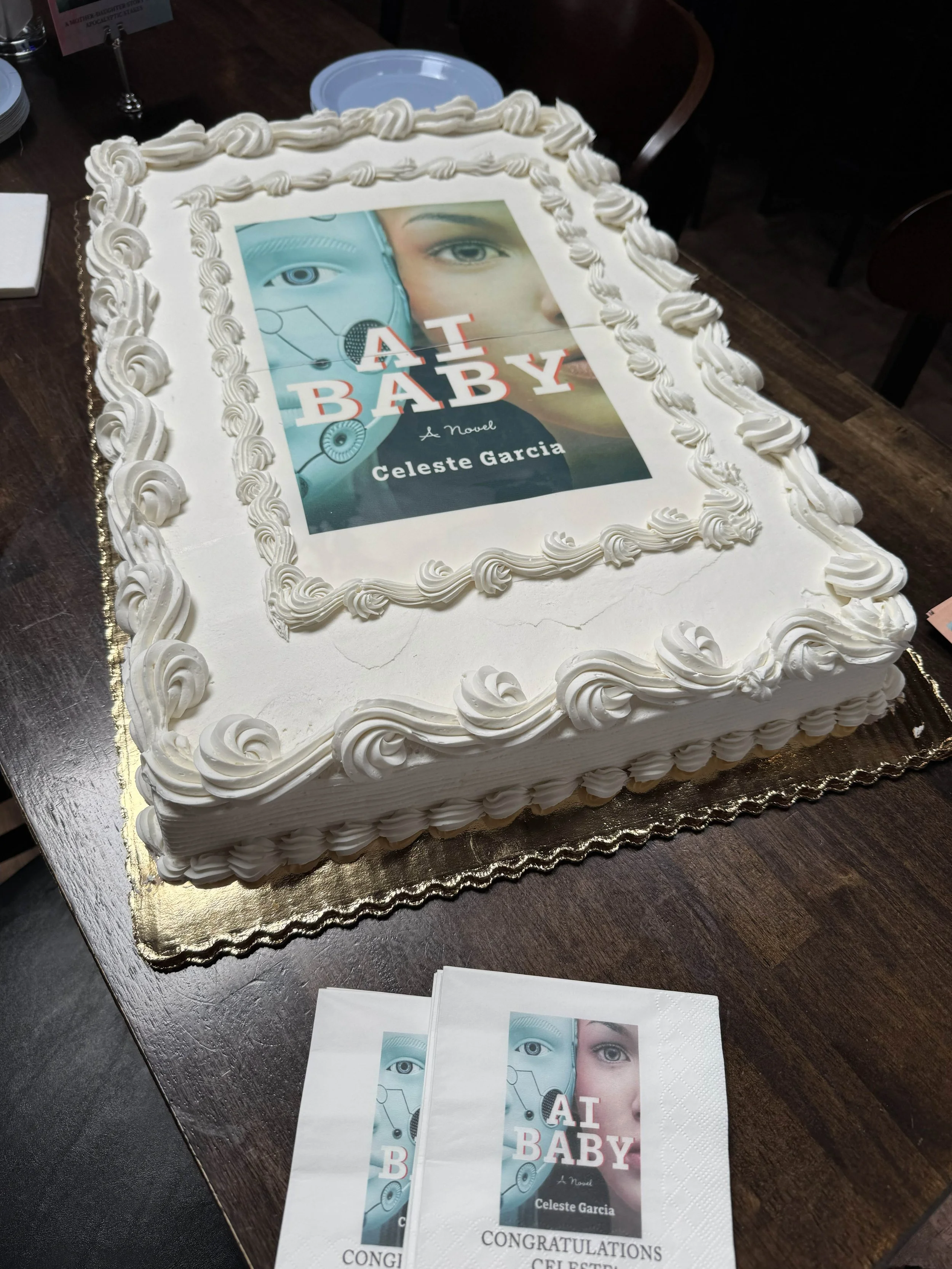
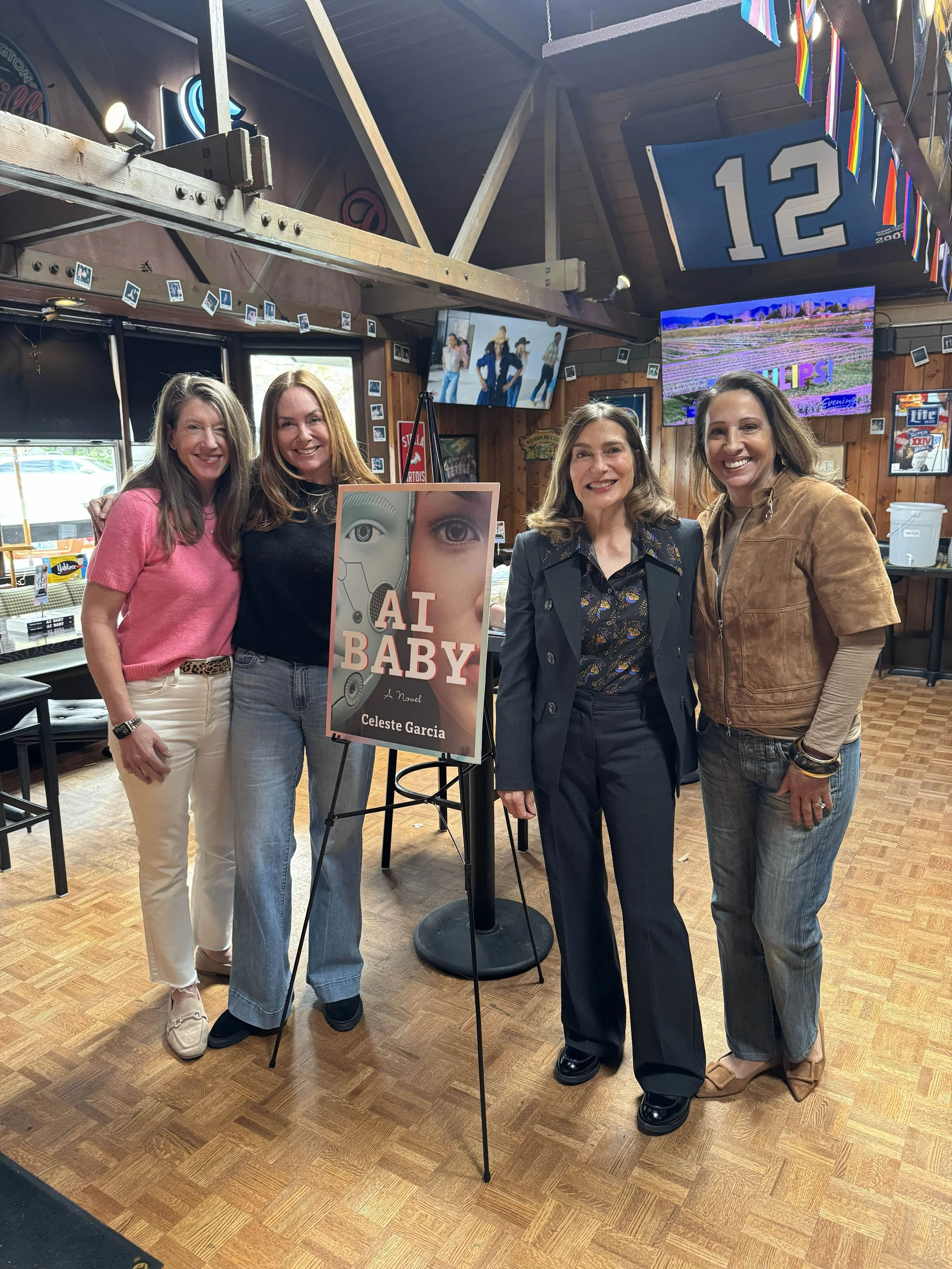
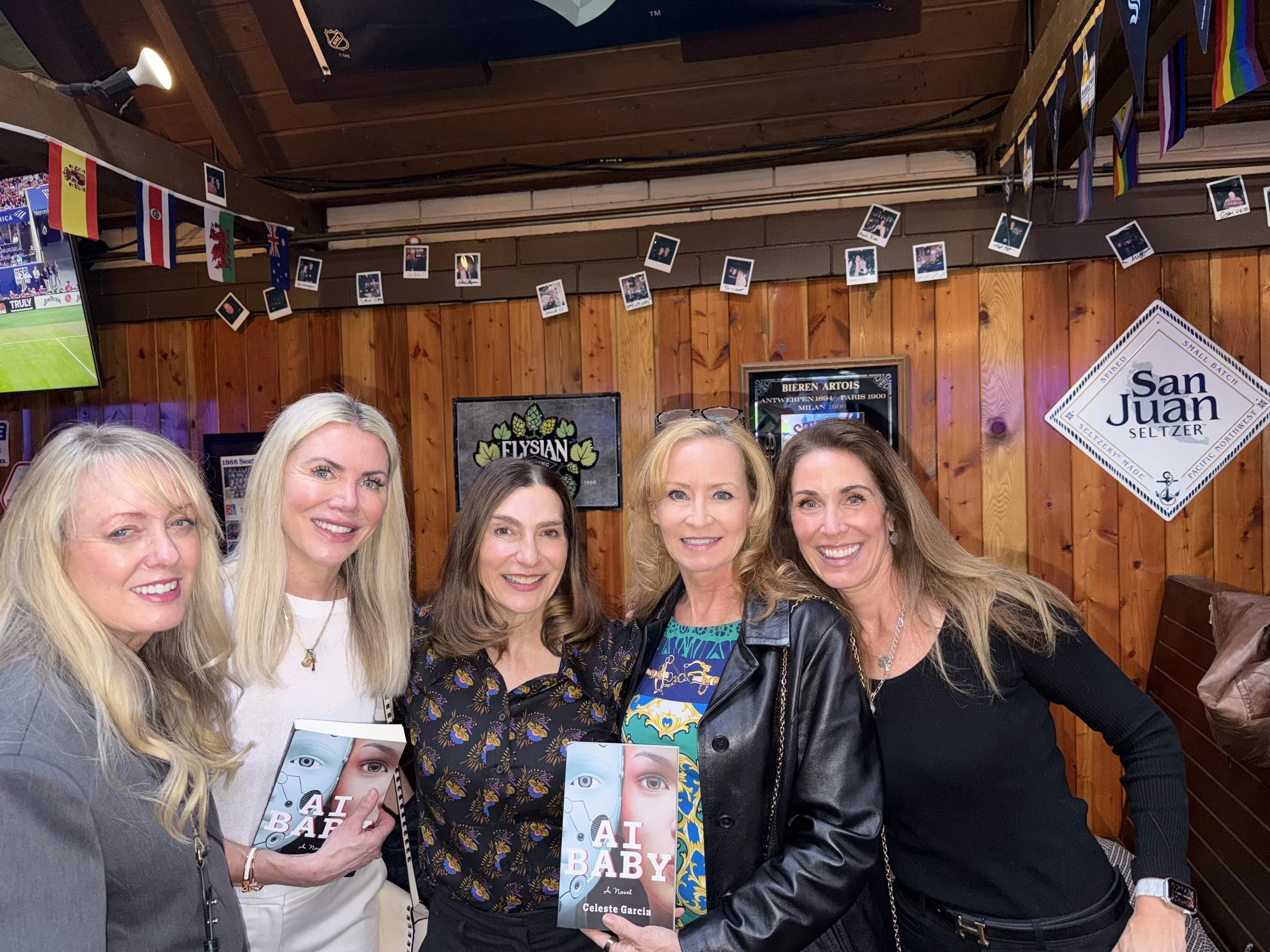
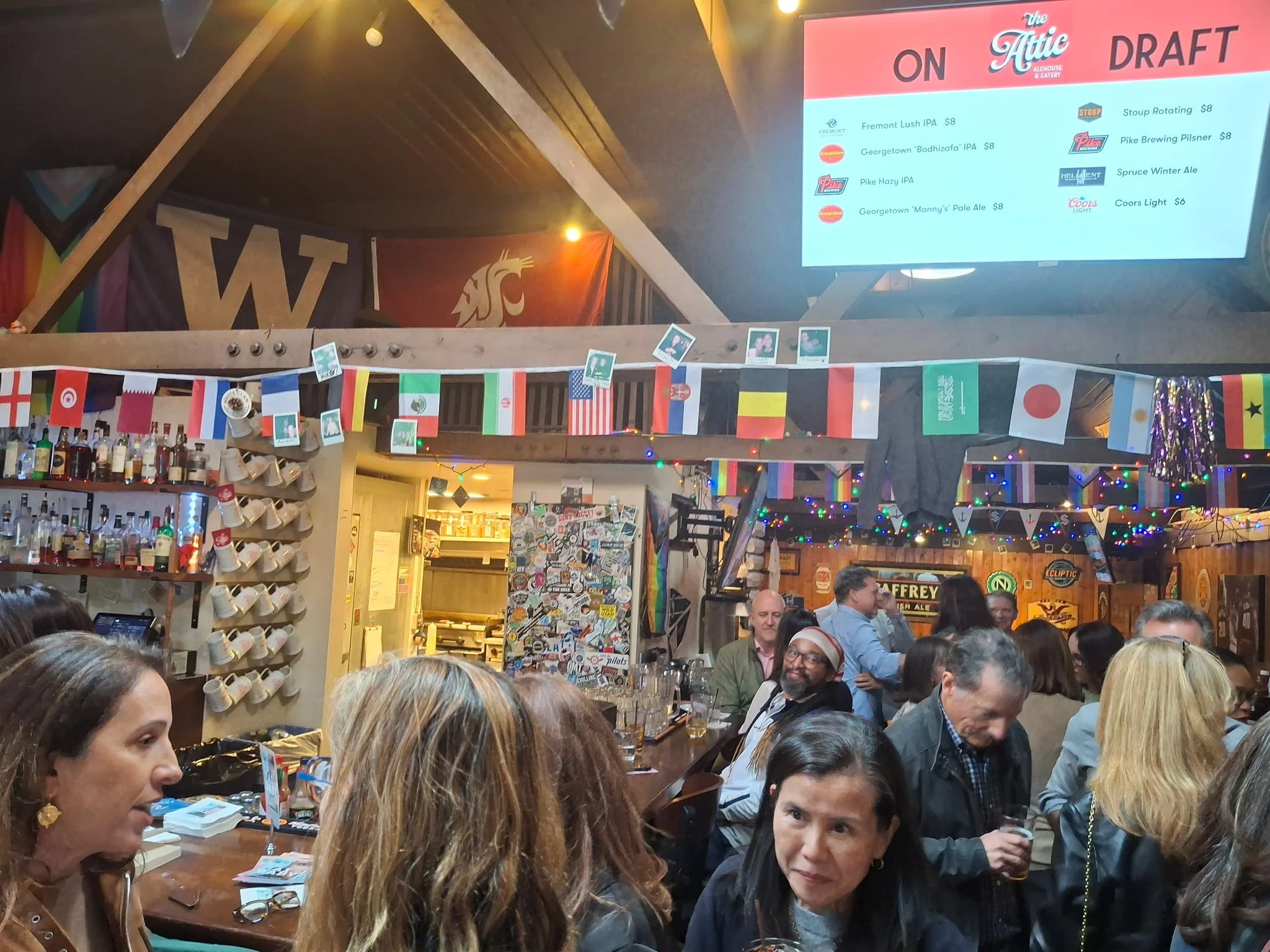
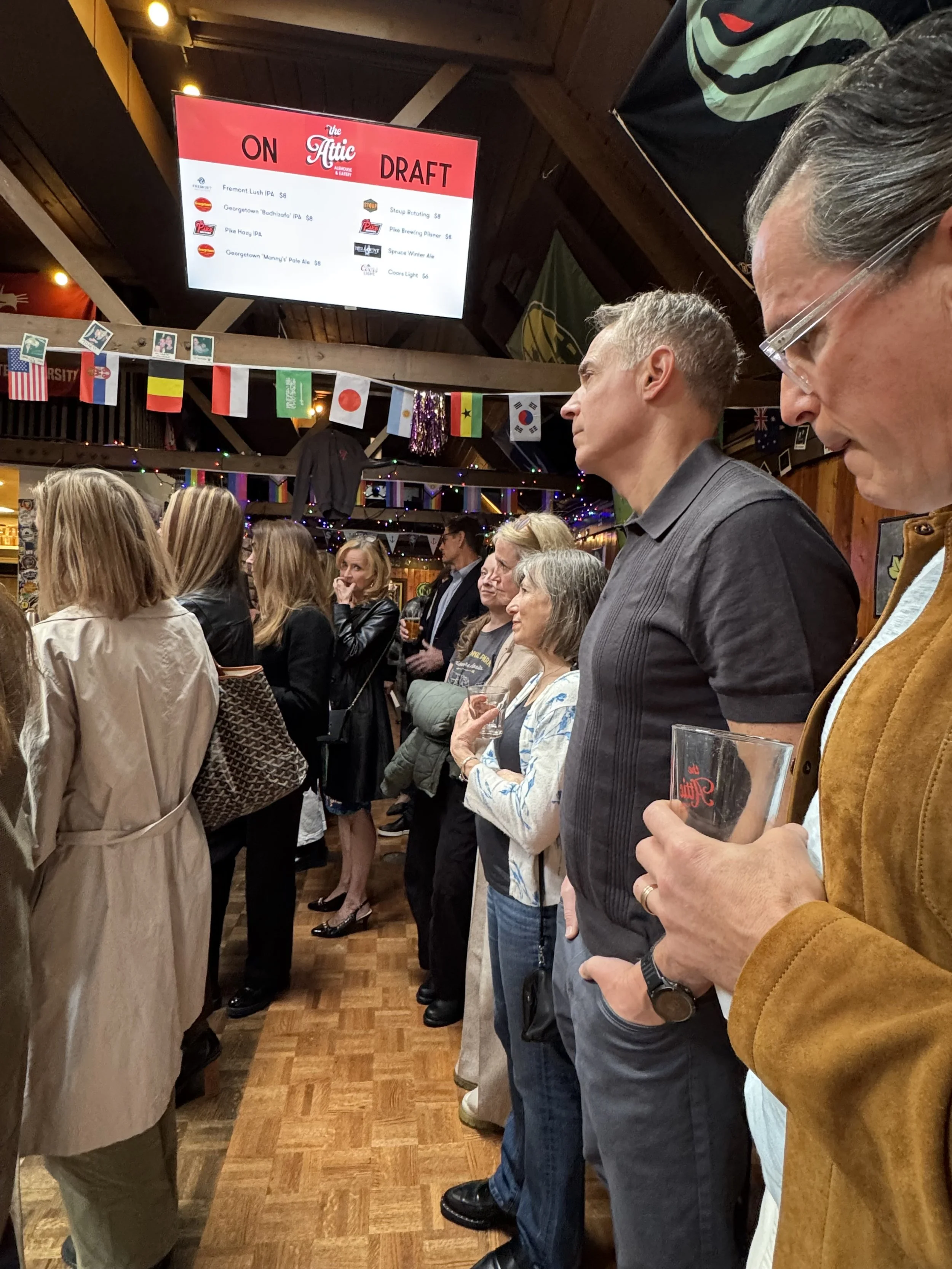
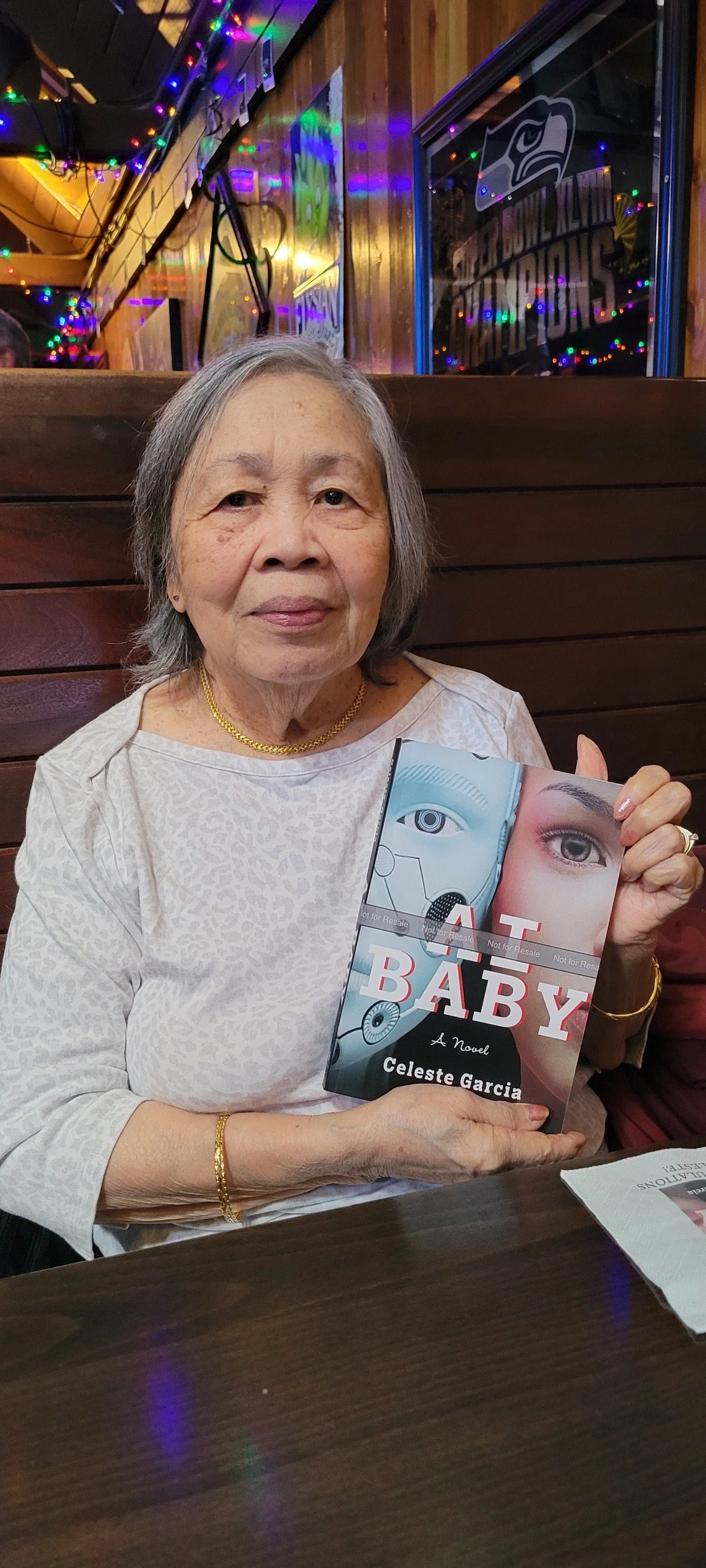
A 100+ good friends gathered at The Attic in Madison Park, Seattle to celebrate the launch of AI Baby! And yes, there was cake….
“AI BABY has compelling, complex characters and a strong story that could be less fictional than many think…I couldn’t wait to see how it turned out…Brava!”
— Karen Smiley, SheWritesAI